

Your knees absorb about three times your body weight with every stride you take. That force changes dramatically depending on whether you’re pounding concrete sidewalks or gliding across a cushioned track.
A 150-pound runner generates roughly 450 pounds of impact per footstrike on hard pavement, while softer surfaces can reduce that by 20-30%.
Here’s what each surface actually does to your joints, and which ones might be quietly setting you up for injury.
How Concrete, Asphalt, and Trails Change Impact on Your Joints
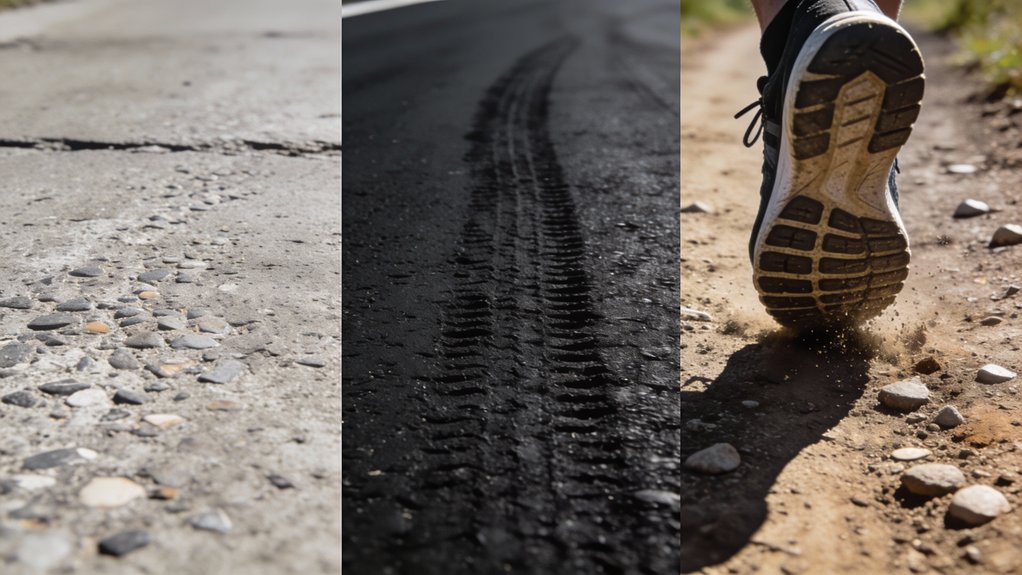
When your foot strikes the ground, the surface beneath it determines how much force travels back through your joints.
Concrete delivers the hardest blow: it can’t absorb shock, which creates peak impact forces that increase your injury risk.
Asphalt’s slightly softer, cutting those forces by 8-12%. That’s better for your knees and hips during long runs.
Trails offer the gentlest joint impact in this surface comparison, though they’ll work your hip stabilizers 23% harder.
The trade-off? Uneven ground means you’re more likely to twist an ankle.
Your choice depends on what matters more to you.
Why Harder Surfaces Increase Stress Fracture Risk
Those joint impacts you feel on concrete don’t just stress your knees, they crack bones from the inside out.
Surface hardness matters because asphalt and concrete can’t absorb shock, forcing your skeleton to handle repeated impacts that exceed safe load thresholds.
Hard surfaces transfer impact directly to your bones because they can’t absorb shock like softer terrain.
You’ll face 15% greater muscle activation in your lower legs, which accelerates fatigue and compromises your natural shock absorption.
Research confirms tibial stress fractures occur considerably more often on hard surfaces.
For injury prevention, you need softer alternatives or at least varied terrain.
Your bones adapt slowly, roughly eight weeks, but damage accumulates daily on unforgiving pavement.
Trail Running: Slower Pace, Stronger Stabilizer Muscles
Although trail running forces you 10-15% slower than road work, that reduced pace delivers substantial strength gains you can’t replicate on flat pavement.
The trail benefits start with your hips: those stabilizing muscles fire 23% harder as you navigate roots, rocks, and uneven ground.
Your ankles gain serious mobility through constant micro-adjustments, building strength from your feet upward.
Each stride becomes integrated training, engaging different muscle groups simultaneously while hills spike your cardiovascular fitness.
Incorporating strength training and plyometrics into your trail running routine further enhances the injury prevention benefits and explosive power development that uneven terrain naturally provides.
You’re not just running, you’re developing the kind of resilient, adaptive strength that keeps you moving freely across any terrain.
Track Running: Predictable Footing With Repetitive Curve Stress

Track running flips the script on terrain challenges.
You’ll find consistent, predictable footing that lets you nail your pacing without dodging roots or rocks. The cushioned surface cuts your stress fracture risk compared to concrete pounding.
Track benefits include that uniform surface supporting your most efficient stride mechanics, perfect for speed sessions and race prep.
The track’s predictable surface unlocks your cleanest running form, making it ideal for dialing in speed work and race-day preparation.
Here’s the catch: those endless curves create repetitive stress on your ankles, knees, and hips.
Smart curve management means alternating directions every few laps and mixing in straightaway work. Complement your track work with strength training for core and legs to stabilize joints through the repetitive turning motions.
You’re free to focus purely on form and tempo, but respect those turns.
Treadmill Running: Altered Knee Flexion and Reduced Proprioception
Treadmills offer climate control and convenience, but they fundamentally change how you run. The fixed belt increases your knee flexion beyond natural patterns, altering treadmill biomechanics that evolved over millions of years.
You’re missing vital ground feedback. That flat, consistent surface creates proprioception deficits your body needs to navigate real terrain. Your stabilizing muscles barely engage on this monotonous platform.
The repetitive motion pounds your joints without varied shock absorption, stacking up overuse injuries over time.
You’ll find your cardiovascular response differs from outdoor running too. That controlled environment can’t replicate the physiological demands of actual ground beneath your feet.
Grass and Sand: Lower Impact, Higher Achilles Tendon Risk
Natural surfaces promise relief from the pounding you get on pavement, and grass or sand certainly deliver softer landings.
Grass benefits include reduced joint stress, though you’ll absorb 25% more shock than on asphalt, risking muscle fatigue.
Grass eases joint impact but paradoxically delivers 25% more shock absorption than asphalt, increasing muscle fatigue risk.
Sand’s instability cuts impact forces but strains your Achilles tendon more than harder ground. Both surfaces demand extra work from your lower legs, building strength while elevating injury risk.
Sand drawbacks intensify on longer runs: you’ll burn more energy maintaining pace and potentially overstress tendons.
Wet grass turns slippery and uneven, threatening ankle sprains.
These softer surfaces aren’t free passes; they trade one challenge for another.
Matching Running Surfaces to Your Injury History
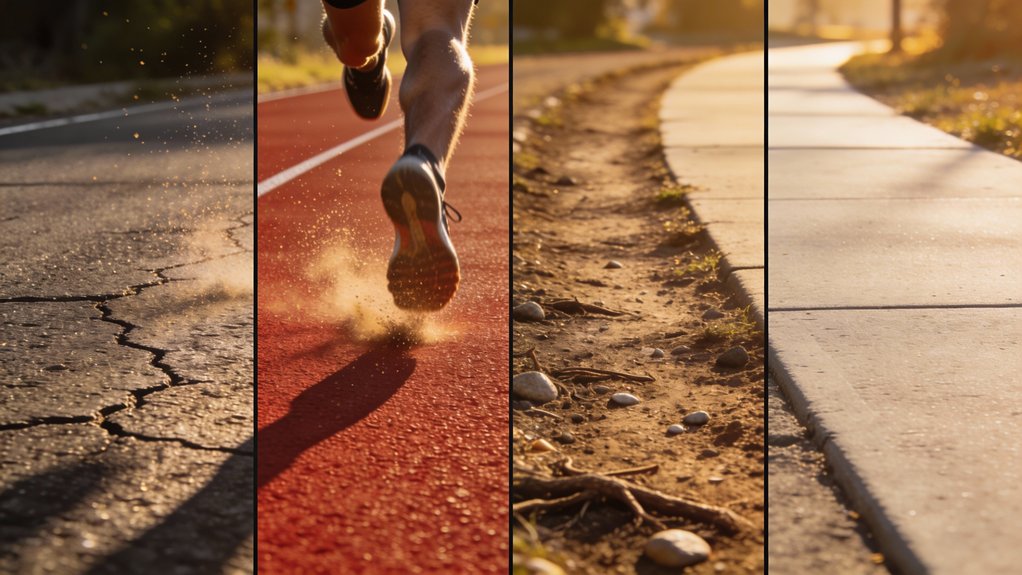
Your injury history should dictate where you run, not the other way around.
If you’ve dealt with knee problems, softer surfaces like grass or rubber tracks absorb impact better than concrete.
For shin splints, alternate between trails and grass to reduce repetitive stress.
Bad ankles? Skip sandy beaches and rocky paths, they’ll twist your joints.
A smart surface selection strategy means varying your terrain to strengthen different muscles and prevent re-injury.
That’s solid knee injury prevention right there.
Listen to your body’s signals.
Pain on pavement? Switch to something gentler.
You control your training, not your past injuries.
Which Surface Should Beginners Start With?
Where should a new runner take those first steps? Your best bet is grass or rubber tracks, they’ll protect your joints while you’re building foundational strength.
The grass benefits include natural cushioning that forgives beginner mistakes.
Here’s your progression plan:
- Start with grass or rubber tracks for your first 4-6 weeks to establish proper form.
- Introduce asphalt gradually once you’ve built base strength, watching for shin discomfort.
- Avoid concrete initially, it’s unforgiving and increases injury risk.
Surface changes matter. Listen to your body as you mix things up.
Sand strengthens legs but risks ankle twists, so approach it carefully once you’ve gained experience.