

Ask any first-timer what worries them about their first sprint triathlon, and transitions come up fast.
Not the swim. Not the bike. The part in between, where everyone seems to know exactly what they are doing and you are not sure where to even stand.
Transitions are the most teachable part of the race. They are the fourth discipline nobody warns you about, and they get simpler the moment someone shows you the shape.
Here is that shape.
What T1 and T2 actually are
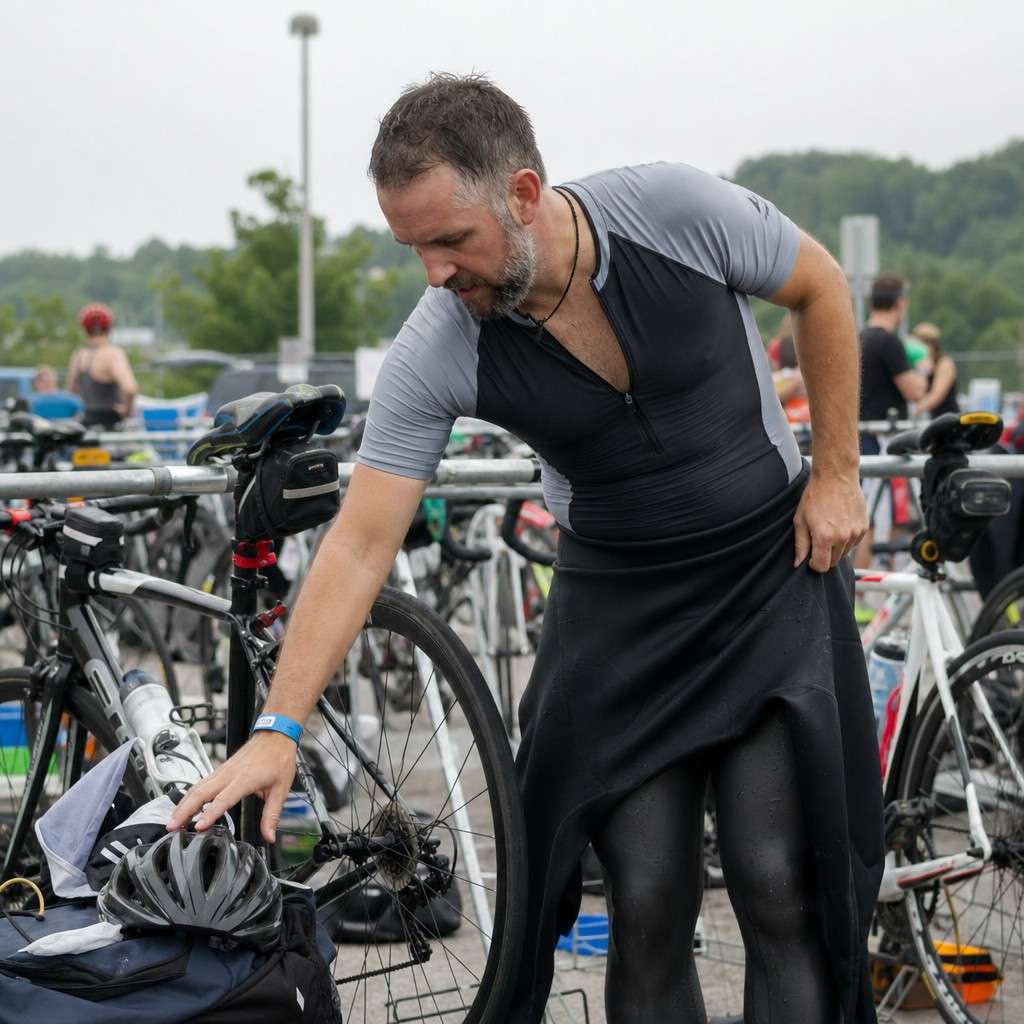
A triathlon does not pause between the swim, bike, and run. You move continuously, and the time keeps running through the changes.
T1 is the transition from swim to bike. You come out of the water, strip off your wetsuit if you wore one, put on your helmet and shoes, and roll your bike out.
T2 is the transition from bike to run. You rack your bike, swap your shoes, and go.
Both transitions sit inside the transition area, which is a defined section of the race venue. Understanding how the distances connect across the full triathlon format helps put the transitions in context: they are short, but they are real parts of the race clock.
Your T1 and T2 times appear in your official results. So they are worth a few minutes of practice, but they are not worth stressing over.
How the transition area is laid out
The transition area is usually a fenced section with rows of metal racks. Each rack holds bikes, and each spot on the rack is numbered.
When you arrive on race morning, your bib number tells you which rack and which spot is yours. You set up your gear there, and you return to exactly that spot between each leg.
The transition area stays the same all race. Once you know where your rack is, the chaos turns into a simple loop: in from the water, back to your rack, out with your bike. Then back to your rack, bike racked, out on the run.
Finding your spot matters more than setting it up perfectly. Walk from the swim exit to your rack. Walk from your rack to the bike mount line. Walk from the rack to the run exit. Do all of this before the race starts, slowly, until the path feels automatic.
Look for a landmark near your rack, something easy to spot at speed, like a bright bag, a colored towel, or a corner post. Rows of identical bikes look a lot alike when your heart rate is up.
What to lay out, and in what order
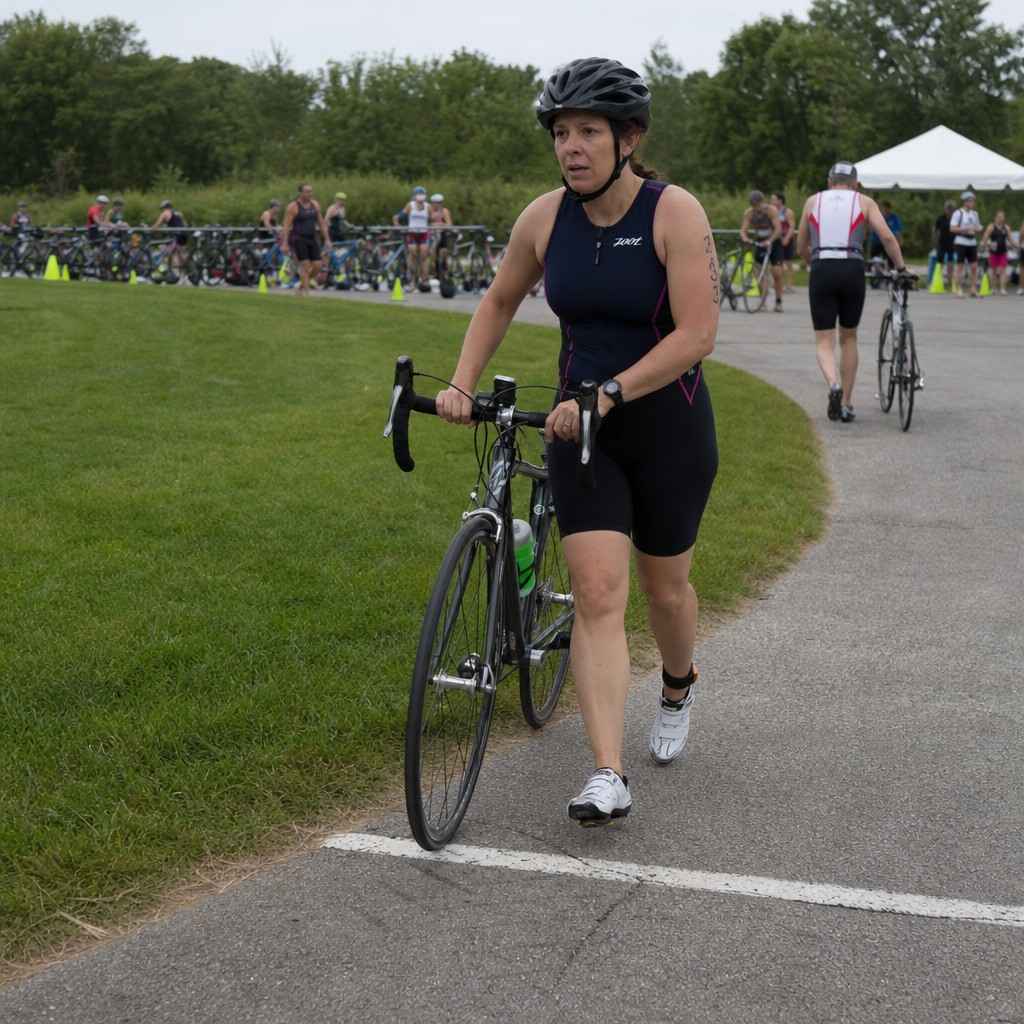
Lay your gear on the ground in front of your bike, in the sequence you will use it. The order itself is the system.
T1 setup (swim to bike):
- Towel or small mat (optional, to stand on while you strip)
- Cycling shoes, open and ready, or running shoes if you are using one pair
- Helmet, open, sitting on top of your shoes or beside them
- Sunglasses inside the helmet if you want them
- Anything else you plan to wear on the bike
T2 setup (bike to run):
- Running shoes, if different from your bike shoes
- Race belt with your bib number clipped to it, coiled loosely on top
That is the whole list for a first sprint. Resist the urge to add more. Every item you add is one more thing to fumble with a clock running.
The goal of setup is the one where you could do it with your eyes half-open. Because after the swim, that is roughly how awake you will feel.
The T1 steps: swim to bike
You come out of the water. Here is what happens next, in order.
- Pull your goggles and swim cap off as you run toward the transition area. Do it while you are moving, not when you get there.
- Find your rack. Use the landmark you identified before the race. Walk if you need to, but move with purpose.
- Strip your wetsuit to the waist while you move. Unzip it at the back, pull your arms out, and let the top half hang. You have time; this is also while you are moving.
- At your spot, sit or step and pull the wetsuit off your legs. Push it down in a smooth roll, step out cleanly. This is where most first-timers lose the most time, not because they are slow, but because the wetsuit grabs an ankle and they panic. Practice it once at home, with a wet suit, before race day.
- Put your helmet on and fasten it before you touch your bike. This is not optional in a sanctioned race.
- Put your shoes on, or clip them to the pedals if you are doing a flying mount (most beginners skip the flying mount and put shoes on at the rack).
- Grab your bike by the seat or handlebars, walk it to the mount line, and go.
Helmet before you touch the bike. That rule exists in writing in USA Triathlon’s race regulations, and it is enforced. Picking up your bike before your helmet is fastened earns a penalty.
The T2 steps: bike to run
You come in on the bike, legs tired, heart rate high. Here is the sequence.
- Dismount before the dismount line, not at it. Beginners often clip it exactly and lose a second or two collecting themselves. Stop cleanly a meter early.
- Run your bike to your rack spot. You do not need to jog fast; just keep moving.
- Rack your bike. Most racks use a horizontal bar; hang the bike by the saddle or nose of the seat, whichever the race rules specify.
- Take your helmet off after the bike is racked. This is the T2 version of the same rule.
- Swap your shoes. If you are using a race belt, clip it on as you go.
- Go. Do not linger. Your legs will feel strange for the first minute, and the only fix is running.
A race belt clips around your waist in about three seconds and holds your bib number for the run with no pinning. It is one of the few small purchases that actually earn their keep, and you can compare triathlon race belts on Amazon before your first race.
The first minute of T2 running is called the “dead legs” feeling. Your legs have been spinning on a bike, and they resist the switch to running. It fades. Keep moving and it stops.
The mistakes first-timers make
Most transition mistakes come from the same source: stopping, second-guessing, and forgetting the order.
The specific ones to watch for:
- Picking up the bike before the helmet is fastened. Penalty. Helmet first, always.
- Not knowing where the rack is. Solved entirely by that pre-race walk.
- Bringing too much gear. Every extra item is extra confusion. Strip back to the minimum.
- Changing everything at once. One thing at a time, in sequence, steady beats fast and frantic.
- Standing still. You are allowed to move slowly. You are not allowed to stop thinking and stand there.
The wetsuit ankle is the classic hold-up. Roll it down rather than pulling it. If you practiced once at home, it will not surprise you.
How to practice transitions at home
You do not need a race venue to practice. You need your gear, a small patch of floor, and five minutes.
Set your transition area up on the floor of your garage or hall: towel down, shoes open, helmet ready. Put on your wetsuit, or a long-sleeve shirt if you are not using a wetsuit. Then practice T1: strip it off, put the helmet on, buckle it, step into your shoes.
Then reset. Practice T2: come in, pretend to rack the bike, take the helmet off, swap shoes, go.
Do it three times. By the third time, it will feel obvious. That is the whole goal.
The goal of a first triathlon is to finish and enjoy it, not to chase a time. A calm, methodical transition that costs you two extra minutes is far better than a rushed one that costs you a penalty and a wasted moment of panic.
One last thing about the clock
The transition clock runs from when you enter the transition area to when you leave it. It does not care whether you are moving efficiently or standing confused by your own shoes.
The way to feel calm inside that clock is to have done all of this before. Once in the driveway. Once at a local try-a-tri or open practice day if your area has one.
Runners have a head start here too. You are already comfortable in race conditions, used to a nervous start, and practiced at keeping your head when your legs are working hard.
Transitions are one more thing you will figure out. They feel mysterious right up until you have done one, and then they feel like part of the race.
Which is exactly what they are.